
Field guide / Morocco · Marrakech · 6 min read
Marrakech Medina for First-Time Visitors
Marrakech medina is not a place you simply check off a list. It is a dense network of neighborhoods that requires a bit of tactical planning to enjoy. Navigating the thousand-year-old lanes is easier when you treat Jemaa el-Fna as your primary anchor and move outward in specific corridors. Instead of wandering aimlessly, pick a clear direction—either north toward the craft souks and the Ben Youssef Madrasa or south toward the palaces—to avoid the exhaustion that comes with getting turned around in the heat.
How to handle your arrival and luggage
Before you even land, get clarity from your riad about where your transport actually stops. Most riads in the medina are inaccessible by car. You will likely be dropped at a gate like Bab Doukkala or a specific parking area. Ask your host if they provide a staff member to meet you at the drop-off point. Walking through the medina with suitcases while trying to read a phone screen is the easiest way to get targeted by unofficial guides offering 'help' you didn't ask for.
If you are arriving after dark, having a pre-arranged transfer is usually worth the extra effort. The lighting in the deep interior alleys can be dim, and landmarks look different at night. If you choose to take a petit taxi from the train station or airport, insist on the meter or agree on a firm price before the bags go in the trunk. Once you arrive at the drop-off point, use a luggage porter with a wooden cart only if you have heavy bags, and agree on the tip beforehand to avoid an awkward exchange at the riad door.
Orienting yourself at Jemaa el-Fna
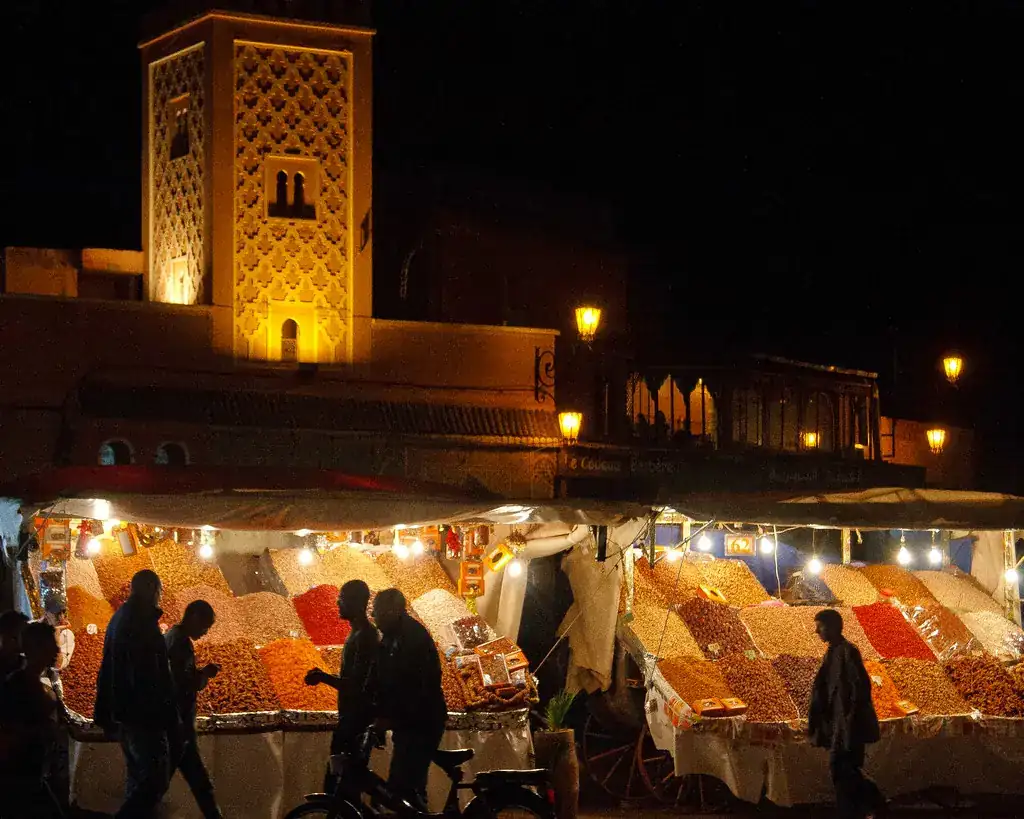
Jemaa el-Fna is the center of the Marrakech universe. Use the Koutoubia minaret as your North Star; it is visible from many rooftops and open squares, helping you figure out which way is 'out' toward the new city. When you first enter the square, walk the perimeter to see where the major arteries like Rue Souk Semmarine and Rue Riad Zitoun el-Kedim begin. This helps you visualize the medina as a wheel with spokes rather than a random maze.
The square changes entirely between midday and evening. During the day, it is open and relatively quiet, but by dusk, the food stalls and performers arrive, and the density of people increases significantly. If you need a breather, head to one of the terrace cafes overlooking the square. It gives you a chance to watch the movement from above and plan your next move without being approached. If you stop to watch a performance or take a photo of an animal, a tip will be expected immediately.
Walking the northern souks toward Ben Youssef
To see the heart of the artisanal workshops, head north from the square into Souk Semmarine. This is the widest path, but it quickly splits. If you keep right, you move toward the spice markets and the Rahba Kedima square. If you bear left, you head toward the Mouassine neighborhood. The further north you go, the more specific the trades become, leading eventually to the Ben Youssef Madrasa, a logical turnaround point for a morning walk.
Navigation in this area is tricky because the narrow roofs often block GPS signals. Look for the small signs on the walls that point back toward Jemaa el-Fna. If you find yourself in the tannery district further east, be prepared for a strong smell and pushy touts. Unless you are specifically looking for that experience, the central souks offer plenty of craftsmanship without the high-pressure sales tactics.
The southern circuit: Palaces and the Kasbah
The southern part of the medina feels different: the streets are slightly wider and the atmosphere is more residential. Walking down Rue Riad Zitoun el-Kedim takes you toward the Bahia Palace and the ruins of El Badi Palace. These two sites are close to each other but look nothing alike. Bahia is about intricate tilework and painted cedar wood, while El Badi is a massive, sunken courtyard that gives you a sense of the scale of the Saadian dynasty.
Continue further south to reach the Kasbah district. This is where you will find the Saadian Tombs and the Bab Agnaou gate. The Kasbah is often a bit quieter than the main souks near the square. If you are planning to visit the tombs, go early in the morning to avoid the queue that forms in the narrow entrance passage. This area is also a good place to find a taxi if you are too tired to walk back, as the roads near the Royal Palace are open to vehicles.
Managing traffic and street etiquette
The medina lanes are shared by pedestrians, donkey carts, and motorbikes that move surprisingly fast. When you hear the shout of 'Balak!' it means move aside immediately. Don't stop abruptly in the middle of a lane to check your map; pull into a shop doorway or a side alley to get your bearings. This keeps you out of the flow of traffic and makes you less of a target for street hustlers.
If someone tells you a street is 'closed' or that 'the mosque is finished for the day,' it is almost always a tactic to redirect you toward a specific shop or a different area where they will expect a tip for 'guiding' you. Politely decline and keep walking. If you genuinely get lost, ask a shopkeeper inside their store rather than someone standing on the street corner. They are less likely to leave their business to follow you.
Do you actually need a guide?
It comes down to patience. If you enjoy finding your own way and stopping for coffee whenever you like, you don't need one. For your first morning, a licensed guide can shield you from the constant offers in the souks and explain the history behind the unmarked doors. If you do hire one, make sure they are official (look for the badge) and say clearly if you do not want a shopping tour.
A half-day tour is usually enough to get your bearings. Ask the guide to show you the different quarters, such as the dyers, the ironworkers and the woodworkers, so you can return to them later on your own. If you are staying deep in the medina, spend your first afternoon just walking the route between your riad and the nearest major gate. Once you have mastered that single path, the rest of the city feels much less intimidating.
A place to start
Experiences in Marrakech
Browse current activities and check the route, meeting point, inclusions and cancellation terms before booking. This is a search, not a personally reviewed tour.
Plan the next step
Activities in Marrakech
Browse current GetYourGuide and Viator listings for Marrakech. Compare the route, meeting point, inclusions and cancellation terms before booking.
Disclosure: these are GetYourGuide and Viator partner links. If you book through them, Real Morocco Guide may earn a commission at no extra cost to you. Listings, prices and reviews come from the providers, not from us. How we work
Also on GetYourGuide
Plan your time
Before you go
Choose what matters most
Use the chapters above to decide what you want to see, then check current access and travel arrangements.
When comparing
Allow for the full journey
Compare meeting points, time on the road and time at the destination, not only the advertised duration.
Before paying
Confirm the details
Read the current provider listing for inclusions, accessibility needs and cancellation terms.
More ways to explore
Choose between exploring independently and comparing guided experiences. Search results are not selected or reviewed tours; confirm all details with the provider.
Explore independently
Use the planning notes above, then verify transport, access and opening details directly before setting out.
Compare guided options
Check what each listing actually includes, the meeting point and how much free time is available.
Explore options ↗Good to know
- Check current transport and access details before leaving.
- Ask the operator about any mobility or dietary needs before booking.
- Keep time in your schedule for changes to the route or weather.
Compare available experiences
Check current inclusions, reviews and cancellation terms with the provider.
Frequently asked questions
Should I book an experience in advance?
It depends on your travel dates and the activity. Check current availability and cancellation rules directly with the provider.
What should I check before reserving?
Confirm the meeting point, what is included, total time commitment, accessibility arrangements and the latest cancellation policy.
Further reading
Background reading, not verification of individual tour listings.
Trusted resources
Official sources worth checking before you travel. We are not affiliated with them.
Keep exploring
Merzouga · 9 min read
Merzouga Desert Safari: Planning an Erg Chebbi Stay
How far Merzouga really is, how sunset trips, camp nights and multi-day tours differ, and what to pack for a night in the Erg Chebbi dunes.
Read guide
Chefchaouen · 9 min read
Chefchaouen Day Trip: How to See the Blue Medina
Whether Chefchaouen works as a day trip from Fes or Tangier, how much time you really get in the blue medina, and when staying the night is the better call.
Read guide